
Growing a plant you cannot see : ex situ propagation of the endoparasite Rafflesia speciosa to strengthen in situ conservation
DOI:
https://doi.org/10.24823/Sibbaldia.2026.3616Abstract
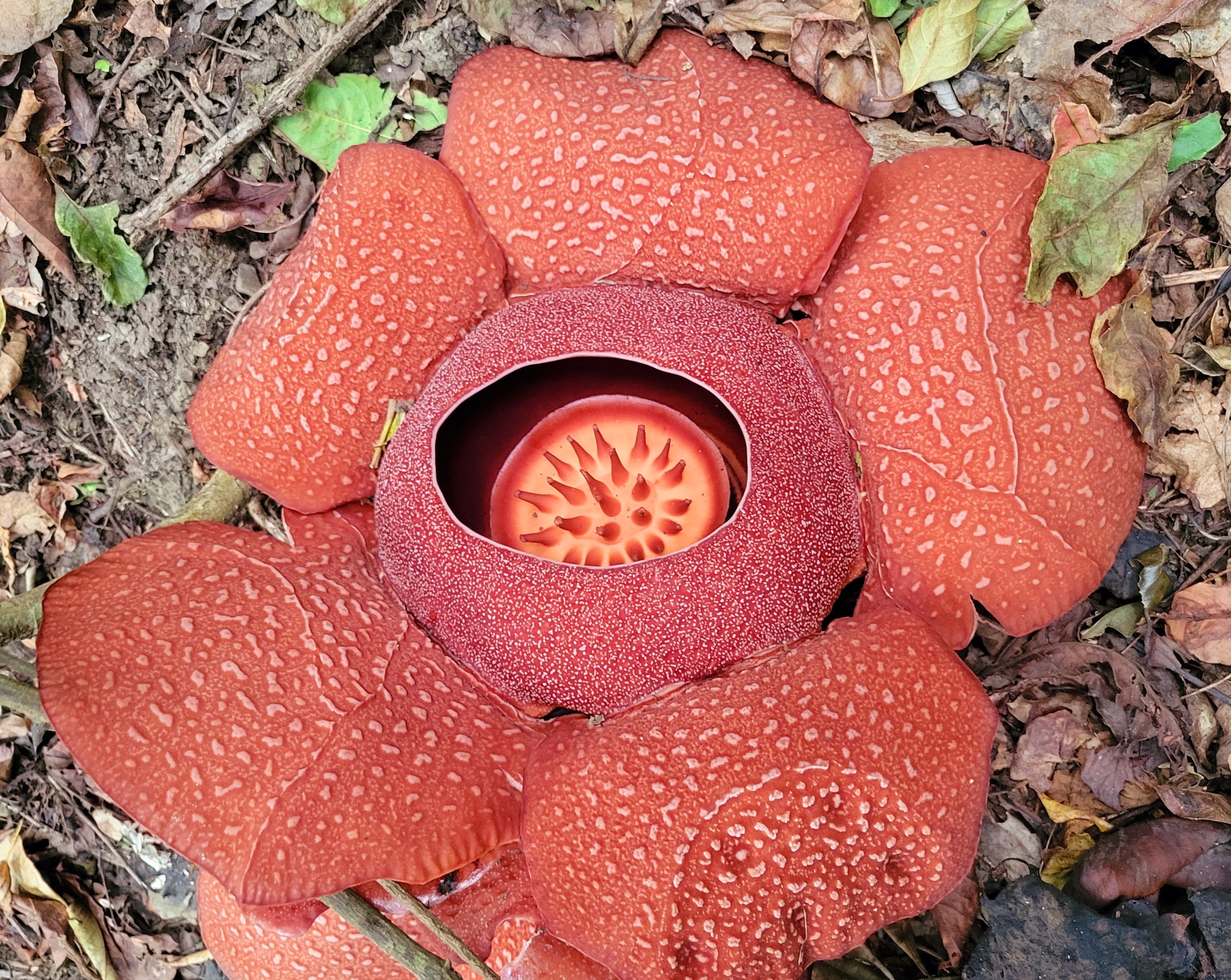
The genus Rafflesia R.Br. ex Gray (Rafflesiaceae) produces the world’s largest flowers, yet most species are critically endangered, making the flower a symbol of global plant conservation. As a holoparasite confined to the woody vines of its sole host, Tetrastigma (Miq.) Planch. (Vitaceae), Rafflesia remains notoriously difficult to study and propagate. Its cryptic endophytic life cycle – persisting as microscopic tissue within its host for years before emergence – has long impeded ex situ conservation, such that its cultivation has aptly been described as ‘growing a plant you cannot see’. Grafting of infected host material has been the only proven method. After more than a decade of diverse attempts, we report the first viable propagation of R. speciosa Barcelona & Fernando-infected pieces sourced from the Philippines at the United States Botanic Garden in Washington, DC – the first documented cultivation of Rafflesia in the Western Hemisphere. Our approach combined two complementary methods: (1) rooting infected stem and root cuttings, and (2) grafting infected root tissues onto established Tetrastigma vines. Infection was verified using a combined molecular (PCR) and histological diagnostic framework. Notably, one graft produced two Rafflesia buds (cupule stage) approximately 2.5 years post-grafting, representing the first evidence of bud initiation outside Southeast Asia. This study (1) establishes replicable glasshouse propagation protocols for Rafflesia-infected Tetrastigma; (2) demonstrates a practical PCR-histological approach for confirming infection prior to budemergence; and (3) shows that infected tissues can preserve endophytic germplasm beyond the lifespan of the original scion. These outcomes were achieved despite the formidable logistical barriers of transcontinental permitting and transport, involving a legally protected Philippine endemic and a US-regulated organism. These methods mark a breakthrough in ex situ Rafflesia conservation, safeguarding vital germplasm and strengthening the future of in situ recovery efforts, enabling the maintenance of this cryptic parasite within its host until it emerges as one of the world’s largest flowers.
This work was funded by NSF #2204938/2346626 to Jeanmaire Molina and by a cooperative grant with the US Botanic Garden.
References
BÄNZIGER, H. (2004). Studies on hitherto unknown fruits and seeds of some Rafflesiaceae, and a method to manually pollinate their flowers for research and conservation. Linzer Biologische Beiträge, 36(2): 1175–1198.
BARCELONA, J.F., PELSER, P.B., BALETE, D.S. & CO, L.L. (2009). Taxonomy, ecology, and conservation status of Philippine Rafflesia (Rafflesiaceae). Blumea, 54: 77–93. https://doi.org/10.3767/000651909X474122
BASCOS, E.M.A., FERNANDO, E.S., DUYA, M.V. & RODRIGUEZ, L.J.V. (2021). Beginnings of a plant parasite: early development of Rafflesia consueloae inside its Tetrastigma host. Planta, 254(61). https://doi.org/10.1007/s00425-021-03710-4
CHENG, T., XU, C., LEI, L., LI, C., ZHANG, Y. & ZHOU, S. (2016). Barcoding the kingdom Plantae: new PCR primers for ITS regions of plants with improved universality and specificity. Molecular Ecology Resources, 16: 138–149. https://doi.org/10.1111/1755-0998.12438
HARTMANN, H.T., KESTER, D.E., DAVIES, F.T., GENEVE, R.L. & WILSON, S.B. (2018). Hartmann & Kester’s Plant Propagation: Principles and Practices, 9th edn. Pearson, New York.
HIDAYATI, S.N., MEIJER, W., BASKIN, J.M. & WALCK, J.L. (2000). A contribution to the life history of the rare Indonesian holoparasite Rafflesia patma (Rafflesiaceae). Biotropica, 32(3): 408–414. https://doi.org/10.1111/j.1744-7429.2000.tb00487.x
LI, J., JIN, Z. & SONG, W. (2012). Do native parasitic plants cause more damage to exotic plants than native ones? A case study using Cuscuta chinensis. PLoS ONE, 7(10): e34577. https://doi.org/10.1371/journal.pone.0034577
MALABRIGO, P., TOBIAS, A.B., WITONO, J., MURSIDAWATI, S., SUSATYA, A., SITI-MUNIRAH, M.Y., WICAKSONO, A., RAIHANDHANY, R., EDWARDS, S. & THOROGOOD, C.J. (2025). Most of the world’s largest flowers (genus Rafflesia) are now on the brink of extinction. Plants, People, Planet, 7(2): 331–346. https://doi.org/10.1002/ppp3.10431
MCMILLAN BROWSE, P.D.A. (1992). Plant Propagation, 3rd edn. Mitchell Beazley, London.
MELNYK, C.W. & MEYEROWITZ, E.M. (2015). Plant grafting. Current Biology, 25(5): 183–188. https://doi.org/10.1016/j.cub.2015.01.029
MICHEL, C.I., MEYER, R.S., TAVERAS, Y. & MOLINA, J. (2016). The nuclear internal transcribed spacer (ITS2) as a practical plant DNA barcode for herbal medicines. Journal of Applied Research on Medicinal and Aromatic Plants, 3(3): 94–100. https://doi.org/10.1016/j.jarmap.2016.02.002
MOLINA, J., MCLAUGHLIN, W., WALLICK, K., PEDALES, R., MARIUS, V.M., TANDANG, D.N., DAMATAC, A. II, STUHR, N., PELL, S.K., LIM, T.M. & NOVY, A. (2017). Ex situ propagation of Philippine Rafflesia in the United States: challenges and prospects. Sibbaldia, 15: 77–96. https://doi.org/10.24823/Sibbaldia.2017.224
MOLINA, J., NIKOLIC, D., JEEVARATHANAM, J.R., ABZALIMOV, R., PARK, E.J., PEDALES, R., MOJICA, E.E., TANDANG, D., MCLAUGHLIN, W., WALLICK, K., ADAMS, J., NOVY, A. ET AL. (2022). Living with a giant, flowering parasite: metabolic differences between Tetrastigma loheri Gagnep. (Vitaceae) shoots uninfected and infected with Rafflesia (Rafflesiaceae) and potential applications for propagation. Planta, 255(4). https://doi.org/10.1007/s00425-021-03787-x
MOLINA, J., WICAKSONO, A., MICHAEL, T., KWAK, S.-H., PEDALES, R.D., JOLY‐LOPEZ, Z., PETRUS, S., MAMERTO, A., TOMEK, B., AHMED, S., MADDU, V., YAKUBOVA, K. ET AL. (2023). The seed transcriptome of Rafflesia reveals horizontal gene transfer and convergent evolution: implications for conserving the world’s largest flower. Plants, People & Planet, 7(2): 448–466. https://doi.org/10.1002/ppp3.10370
MOLINA, J., DE GUZMAN, R., WICAKSONO, A., MUTH, T., PEDALES, R., DIAZ, D., BUDHI KUSUMA, A., LI, C., MARGOLIS, H., KARNITSKIY, F., ESTOPACE, A., ATANELOV, P. ET AL. (2024). The endophyte’s endophytes: the microbial partners of the endangered plant parasite Rafflesia speciosa (Rafflesiaceae) reveal clues about its cryptic biology and cues for cultivation. Journal of Plant Interactions, 19:1. https://doi.org/10.1080/17429145.2024.2304221
MOLINA, J., DE GUZMAN, R., ABZALIMOV, R., HUANG, W., GURUPRASAD, A., PEDALES, R., WICAKSONO, A., DAVIS, D., CALLADO, J.R., BANZIGER, H., SUKSATHAN, P., EATON, W. ET AL. (2025). Microbes and metabolites of a plant-parasite interaction: Deciphering the ecology of Tetrastigma host choice in the world’s largest parasitic flower, Rafflesia. Current Plant Biology, 42: 100456. https://doi.org/10.1016/j.cpb.2025.100456
MOLINA, J. & THOROGOOD, C. (2025). Rethinking the rules of plant life cycles: Insights from the Rafflesiaceae. Haustorium, 88. International Parasitic Plant Society. Available online: www.parasiticplants.org/wp-content/uploads/2025/11/Haust88.pdf (accessed February 2026).
MOREAU, D., VERHOEVEN, K.J.F. & BARBUT, J. (2016). Trophic relationships between the parasitic plant species Phelipanche ramosa and its hosts. Frontiers in Plant Science, 7: 1033. https://doi.org/10.3389/fpls.2016.01033
MURSIDAWATI, S., NGATARI, N., IRAWATI, I., CARDINAL, S. & KUSUMAWATI, R. (2015). Ex situ conservation of Rafflesia patma Blume (Rafflesiaceae): an endangered emblematic parasitic species from Indonesia. Sibbaldia, 13: 99–110. https://doi.org/10.24823/Sibbaldia.2015.77
MURSIDAWATI, S., WICAKSONO, A. & TEIXEIRA DA SILVA, J.A. (2019). Development of the endophytic parasite, Rafflesia patma Blume, amongst host plant (Tetrastigma leucostaphylum (Dennst.) Alston) vascular cambium tissue. South African Journal of Botany, 123: 382–386. https://doi.org/10.1016/j.sajb.2019.03.028
NAIS, J. (2001). Rafflesia of the World. Sabah Parks, Kota Kinabalu.
NIKOLOV, L.A., TOMLINSON, P.B., MANICKAM, S., ENDRESS, P.K., KRAMER, E.M. & DAVIS, C.C. (2014). Holoparasitic Rafflesiaceae possess the most reduced endophytes and yet give rise to the world’s largest flowers. Annals of Botany, 114(2): 233–242. https://doi.org/10.1093/aob/mcu114
PELSER, P.B., NICKRENT, D.L., CALLADO, J.R. & BARCELONA, J.F. (2013). Mt. Banahaw reveals: The resurrection and neotypification of the name Rafflesia lagascae (Rafflesiaceae) and clues to the dispersal of Rafflesia seeds. Phytotaxa, 131: 35–40. https://doi.org/10.11646/phytotaxa.131.1.6
PELSER, P.B., NICKRENT, D.L. & BARCELONA, J.F. (2016). Untangling a vine and its parasite: host specificity of Philippine Rafflesia (Rafflesiaceae). Taxon, 65: 739–758. https://doi.org/10.12705/654.4
PELSER, P.B., NICKRENT, D.L., VAN EE, B.W. & BARCELONA, J.F. (2019). A phylogenetic and biogeographic study of Rafflesia (Rafflesiaceae) in the Philippines: Limited dispersal and high island endemism. Molecular Phylogenetics and Evolution, 139:106555. https://doi.org/10.1016/j.ympev.2019.106555
PLANTS OF THE WORLD ONLINE (2025). Royal Botanic Gardens, Kew. Available online: https://powo.science.kew.org (accessed November 2025).
WICAKSONO, A., MURSIDAWATI, S., SUKAMTO, L.A. & TEIXEIRA DA SILVA, J.A. (2016). Rafflesia spp.: propagation and conservation. Planta, 244: 289–296. https://doi.org/10.1007/s00425-016-2512-8
WICAKSONO, A., MURSIDAWATI, S. & MOLINA, J. (2021). A plant within a plant: insights on the development of the Rafflesia endophyte within its host. Botanical Review, 87: 233–242. https://doi.org/10.1007/s12229-020-09236-w
Downloads
Published
Issue
Section
License
Copyright (c) 2026 Jeanmaire Molina, Mick Erickson, Isabel Emanuel, Stephen Jones, Kirsten Kautz, Benjamin Gutman, Ronniel Pedales, Macario Nicer Napulan, Marites Muyong, Sofi Mursidawati, Ngatari, Pola Geneva Bumanglag, William McLaughlin, Danilo Tandang, John Rey Callado, Mark Moreno, Kyle Wallick, James Hill, Erika Marie Bascos, Alysa Estopace, David Kidwell-Slak, Megan Haidet, Amy Highland, Ray Mims, James Adams, Lisa Philander, Ari Novy, Susan Pell

This work is licensed under a Creative Commons Attribution 4.0 International License.
Please read our Open Access, Copyright and Permissions policies for more information.