
STUDENT PROJECT An investigation into the components of conservation horticulture projects
DOI:
https://doi.org/10.24823/Sibbaldia.2025.2131Keywords:
Conservation, Horticultural techniques, Conservation horticulture, Social research methodsAbstract
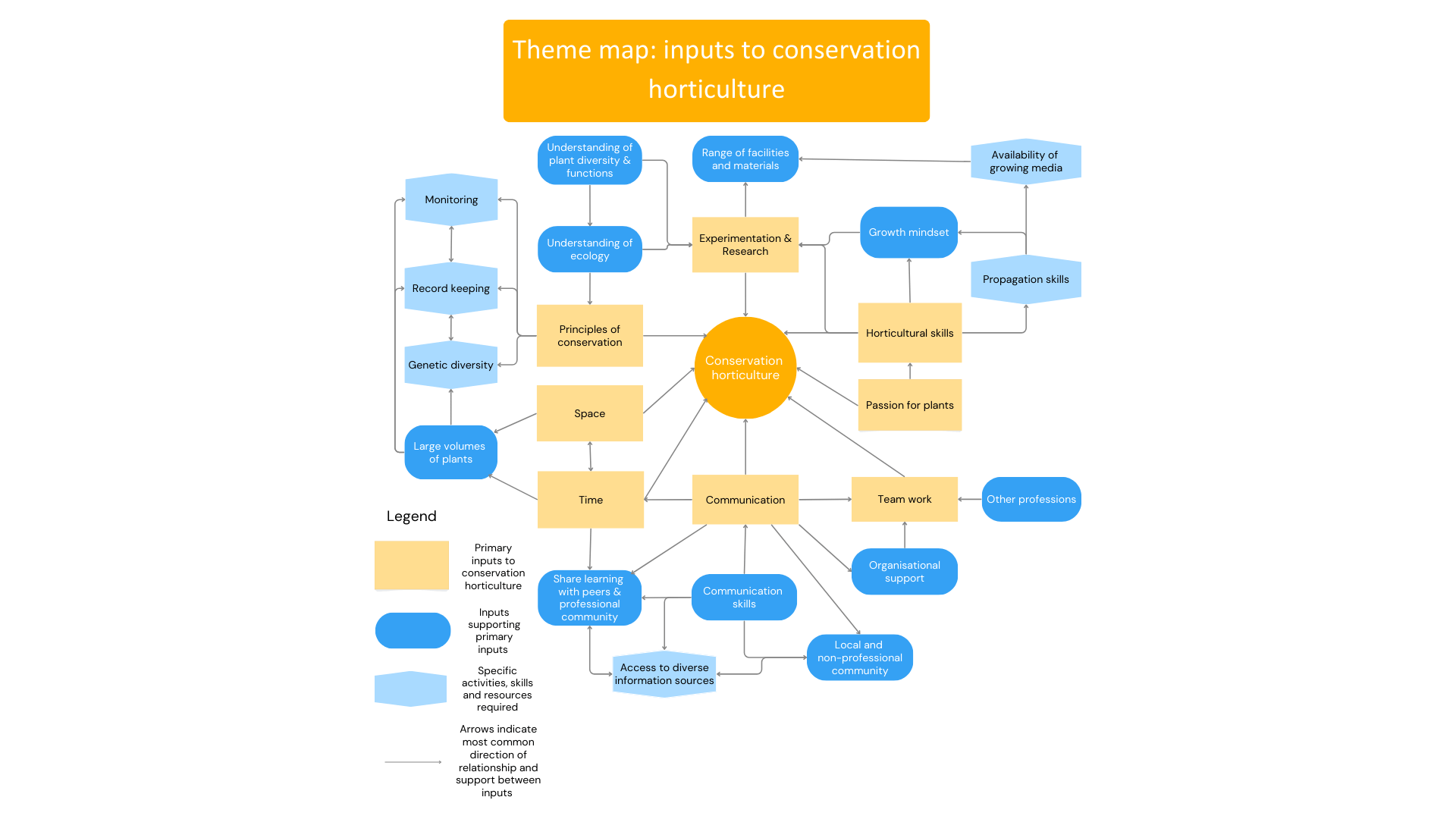
Targets have been set within the Global Biodiversity Framework to increase in situ and ex situ conservation activities to address the biodiversity crisis and impacts of climate change. This paper highlights the horticultural skills and facilities held in botanic gardens that can make an essential contribution to these conservation activities and that are often termed ‘conservation horticulture’. Previously published research identified a lack of cohesion in the use of this term. This research seeks to explain the reasons for this through analysis of both previously published data and new data. New data presented was collected through semi-structured interviews with practitioners involved in conservation horticulture programmes in Europe, Asia, Australasia and North America. Key findings include the need for an understanding of conservation and horticultural principles, and the importance of research, teamwork and communication to deliver conservation horticulture projects. A theme map of the findings is presented as are factors to be considered when planning conservation horticulture projects.
References
AFFOLTER, J.M. (1997). Essential role of horticulture in rare plant conservation. HortScience, 32(1): 29–34. doi: https://doi.org/10.21273/HORTSCI.32.1.29
ALLNUTT, T., THOMAS, P., NEWTON, A.C. & GARDNER, M.F (1998). Genetic variation in Fitzroya cupressoides cultivated in the British Isles assessed using RAPDs. Edinburgh Journal of Botany, 55(3): 329–341. Available online: https://journals.rbge.org.uk/ejb/article/view/953 (accessed February 2025).
BARHAM, E., SHARROCK, S., LANE, C. & BAKER, R. (2015). An International Plant Sentinel Network. Sibbaldia, 13: 83–98. doi: https://doi.org/https://doi.org/10.24823/Sibbaldia.2015.75
BLACKHALL-MILES, R. (2019). Cultivation of Orites myrtoideus. Sibbaldia, 17: 141–154. doi: https://doi.org/10.24823/Sibbaldia.2019.271
BOTANIC GARDENS CONSERVATION INTERNATIONAL (2022). Influence and action: botanic gardens as agents of change. Available online: www.bgci.org/resources/bgci-tools-and-resources/bgci-global-congress-proceedings (accessed February 2025).
BOTANIC GARDENS CONSERVATION INTERNATIONAL (2024). GardenSearch [database]. Available online: https://gardensearch.bgci.org (accessed January 2025).
BOYATZIS, R.E. (1998). Transforming Qualitative Information: Thematic Analysis and Code Development. Sage, Thousand Oaks, CA.
BRAUN, V. & CLARKE, V. (2006). Using thematic analysis in psychology. Qualitative Research in Psychology, 3: 77–101. doi: https://doi.org/doi: 10.1191/1478088706qp063oa
CANO, Á., POWELL, J., AIELLO, A.S., ANDERSEN, H.L., ARBOUR, T., BALZER, A., BAUER, D.S., BUGARCHICH, J., CANO, F., CONTRERAS, M.P., CUBEY, R., CZAJKOWSKI, I. ET AL. (2025). Insights from a century of data reveal global trends in ex situ living plant collections. Nature Ecology & Evolution, 9(2): 214–224. doi: https://doi.org/10.1038/s41559-024-02633-z
CANVA (2025). Free online mind maps. Available online: www.canva.com/graphs/mind-maps (accessed March 2025).
CBD SECRETARIAT (2025). The Targets 2011–2020, Global Strategy for Plant Conservation. Available online: www.cbd.int/gspc/targets.shtml (accessed March 2025).
CLARK, T., FOSTER, L., SLOAN, L. & BRYMAN, A. (2021). Bryman’s Social Research Methods. 6th edn. Oxford University Press, Oxford.
CRUSE-SANDERS, J. (2017). Postcards from the field. Sibbaldia, 14: 141–156. doi: https://doi.org/10.24823/Sibbaldia.2016.205
DÍAZ, S., SETTELE, J., BRONDÍZIO, E., NGO, H., AGARD, J., ARNETH, A., BALVANERA, P., BRAUMAN, K.A., BUTCHART, S.H.M., CHAN, K.M.A., LUCAS, A.G., ICHII, K. ET AL. (2019). Pervasive human-driven decline of life on Earth points to the need for transformative change. Science, 366(6471). doi: https://doi.org/10.1126/science.aax3100
DWECK, C.S. (2007). Mindset: The New Psychology of Success. Random House Inc., New York.
EDWARDS, D., ARMITAGE, J., BILSBORROW, J., DAVID, J., GEBAUER, M., HASSEMER, G., SHAW, J., SHEEHY SKEFFINGTON, M. & KÖNYVES, K. (2022). An investigation of large-leaved Gunnera L. (Gunneraceae) grown outside in Britain and Ireland. Sibbaldia, 22: 77–98. doi: https://doi.org/https://doi.org/10.24823/Sibbaldia.2022.1998
ENTWISLE, T. (2023). Guest Essay: vive l’horticulture de conservation. Sibbaldia, 22: 3–14. doi: https://doi.org/https://doi.org/10.24823/Sibbaldia.2022.1997
ETISHAM-UL-HAQ, M., ALLNUTT, T.R., SMITH-RAMIREZ, C., ARMESTO, J.J. & NEWTON, A.C. (2001). Patterns of genetic variation in in and ex situ populations of the threatened Chilean vine Berberidopsis corallina, detected using RAPD markers. Annals of Botany, 87(6): 813–821. Available online: www.jstor.org/stable/42771000 (accessed February 2025).
FINGER, A., MACDONALD, I. & HOLLINGSWORTH, P.M. (2024). Genetic monitoring for effective plant conservation: An example using the threatened Saxifraga hirculus L. in Scotland. Plants, People, Planet, 6(2): 381–398. doi: https://doi.org/https://doi.org/10.1002/ppp3.10456
FRACHON, N. (2013). Plant health protocols for the reintroduction of native plants. Sibbaldia, 11: 53–60. doi: https://doi.org/10.24823/Sibbaldia.2013.50
GANESHAMURTHY, A.N., RAVINDRA, V., PANNEERSELVAM, P., SATHYARAHINI, K. & BHAT, R.M. (2016). Conservation horticulture in mango orchards: comparative effects of conventional and conservation management practices on soil properties of an Alfisol under seasonally dry tropical savanna climate. Journal of Agricultural Science, 8(7): 173–188. doi: https://doi.org/ 10.5539/jas.v8n7p173
GARDNER, M.F. (2000). The conservation potential of a Chilean conifer and a climber. The New Plantsman, 7(3): 174–177.
GARDNER, M.F. (2021). Managing botanic garden collections of high conservation value. Sibbaldia, 20: 81–94. doi: https://doi.org/https://doi.org/10.24823/Sibbaldia.2021.360
GARDNER, M., CHRISTIAN, T., HINCHLIFFE, W. & CUBEY, R. (2019). Conservation hedges: modern-day arks. Sibbaldia, 17: 71–100. doi: https://doi.org/https://doi.org/10.24823/Sibbaldia.2019.268
GILBERT, M. (2023). Air layering as a propagation method in glasshouse cultivation. Sibbaldia, 22: 171–178. doi: https://doi.org/https://doi.org/10.24823/Sibbaldia.2022.1986
GIVEN, D.R. (1997). Principles and Practices of Plant Conservation. Timber Press, Portland, OR.
GRATZFELD, J. (2017). What is conservation horticulture? BGjournal, 14(2): 14–17. Available online: www.bgci.org/wp/wp-content/uploads/2019/04/BGjournal%2014_2.pdf (accessed December 2024).
HARPERCOLLINS PUBLISHERS (2025). Collins Dictionary Online. Available online: www.collinsdictionary.com/dictionary/english/toolkit (accessed February 2025).
HEYWOOD, V. (1987). The changing role of the botanic garden. In: BRAMWELL, D, HAMANN, O., HEYWOOD, V. & SYNGE, H. (EDS). Botanic gardens and the world conservation strategy: proceedings of an international conference 26–30 November 1985 held at Las Palmas de Gran Canaria. IUCN, Academic Press, London, pp. 3–18.
HIRST, M.J., ARNOTT, J. & LARKE, R. (2023). Raising Rarity: creating meaningful and sustainable conservation outcomes through community-based outreach. Sibbaldia, 22: 99–114. doi: https://doi.org/10.24823/Sibbaldia.2022.2000
HIRST, M.J., GRIFFIN, P.C., WU, L. & HOFFMANN, A.A.S. (2020). Testing the environmental warming responses of Brachyscome daisy species using a common garden approach. Austral Ecology, 45(6): 717–730. doi: https://doi.org/10.1111/aec.12885
HIRST, M.J., MESSINA, A., DELPRAT, J. & MURPHY, S.M. (2019). Raising rarity: Horticultural approaches to conserving Victoria’s rare and threatened wildflowers. Australasian Plant Conservation, 24(4): 14–16. doi: https://doi.org/10.5962/p.373777
HUGHES, K., ENSOLL, A. & GARDNER, M.F. (2014). The cultivation of Valdivia gayana J. Rémy. Sibbaldia, 12: 57–66. doi: https://doi.org/10.24823/Sibbaldia.2014.23
KAY, J., STRADER, A., MURPHY, V., NGHIEM-PHU, L., CALONJE, M. & GRIFFITH, P.M. (2011). Palma Corcho: a case study in botanic garden conservation horticulture and economics. HortTechnology, 21(4): 474–481. doi: https://doi.org/10.21273/HORTTECH.21.4.474
LUSBY, P. & WRIGHT, J. (1996). Scottish Wild Plants. Mercat Press, Edinburgh.
MAGDALENA, C. (2010). Raising the living dead. Sibbaldia, 8: 63–73. doi: https://doi.org/10.24823/Sibbaldia.2010.137
MEYER, A., BRUNS, E., FOSTER, J., MIMS, R. & TOPPILA, R. (2024). Conservation horticulture expertise at botanic gardens. Available online: www.bgci.org/wp/wp-content/uploads/2024/10/BGCI-USBG-Report_-Conservation-Horticulture_final2_10.22.24.pdf (accessed March 2025).
MÖLLER, M., ATKINS, H., BARBER, S. & PURVIS, D. (2019). The Living Collection at the Royal Botanic Garden Edinburgh illustrates the floral diversity in Streptocarpus (Gesneriaceae). Sibbaldia, 17: 155–177. doi: https://doi.org/10.24823/Sibbaldia.2019.272
MOUNCE, R., SMITH, P. & BROCKINGTON, S. (2017). Ex situ conservation of plant diversity in the world’s botanic gardens. Nature Plants, 3: 795–802. doi: https://doi.org/10.1038/s41477-017-0019-3
PRIYA, A. (2021). Case study methodology of qualitative research: key attributes and navigating the conundrums in its application. Sociological Bulletin, 70(1): 94–110. doi: https://doi.org/10.1177/0038022920970318
RAE, D.A.H. (1995). Botanic gardens and their live plant collections: present and future roles. Unpublished PhD thesis, University of Edinburgh. Available online: http://hdl.handle.net/1842/21475 (accessed November 2024).
RAE, D. (2004). The role of horticulture in the Global Strategy for Plant Conservation. Sibbaldia, 2: 95–100. doi: https://doi.org/https://doi.org/10.24823/Sibbaldia.2004.105
SMITH, P. (2021). The need for horticulturist expertise in plant conservation: challenges and opportunities. Sibbaldia, 20: 45–56. doi: https://doi.org/https://doi.org/10.24823/Sibbaldia.2021.316
SMITH, P. (2025). A rude awakening. Botanic Gardens Conservation International News. Available online: www.bgci.org/news-events/a-rude-awakening (accessed February 2025).
STAFLEU, F.A. (1971) (1751). Philosophia Botanica in Linnaeus and the Linnaeans: The Spreading of their Ideas in Systematic Botany. The International Association for Plant Taxonomy, Utrecht.
STANLEY, R. & DYMOND, W. (2020). Reducing risk to wild ecosystems in nursery production. Sibbaldia, 19: 59–68. doi: https://doi.org/10.24823/Sibbaldia.2020.283
SUMMERELL, B. & LIEW, E. (2020). Phytophthora root rot: its impact in botanic gardens and on threatened species conservation. Sibbaldia, 18: 89–104. doi: https://doi.org/10.24823/Sibbaldia.2020.290
TURNER, D.W. (2010). Qualitative interview design: a practical guide for novice investigators. The Qualitative Report, 15(3): 754–760. doi: https://doi.org/https://doi.org/10.46743/2160-3715/2010.1178
WALLACE, S. (1992). Introduction of Conradina glabra; a pilot project for the conservation of an endangered Florida endemic. Botanic Gardens Conservation News, 1(10): 34–39. Available online: www.jstor.org/stable/24755389 (accessed October 2024).
WESTWOOD, M., CAVENDER, N., MEYER, A. & SMITH, P. (2021). Botanic garden solutions to the plant extinction crisis. Plants People Planet, 3(1): 22–32. doi: https://doi.org/10.1002/ppp3.10134
WYSE-JACKSON, P. (1999). Experimentation on a large scale – an analysis of the holdings and resources of botanic gardens. Botanic Gardens Conservation News, 3(3): 27–30. Available online: www.jstor.org/stable/24753880 (accessed March 2025).
YAMADA, J., SHORKEY, A., BARWICK, M., WIDGER, K. & STEVENS, B.J. (2015). The effectiveness of toolkits as knowledge translation strategies for integrating evidence into clinical care: a systematic review. BMJ Open, 5: e006808. doi: https://doi.org/doi:10.1136/bmjopen-2014006808
ZALE, P. & TESTA, K. (2023). Reaching for new heights in rare species conservation. Longwood Gardens Blog. Available online: https://longwoodgardens.org/blog/2023-08-16/reaching-new-heights-rare-species-conservation (accessed March 2025).
Downloads
Additional Files
Published
Issue
Section
Categories
License
Copyright (c) 2025 Kate Hughes

This work is licensed under a Creative Commons Attribution 4.0 International License.
Please read our Open Access, Copyright and Permissions policies for more information.