
CONNATE OVARIES AND MULTIPLE FRUITS IN RUBIACEAE, WITH REDUCTION OF CONJUGATOVARIUM TO SYNONYMY WITH MITCHELLA (RUBIACEAE – MITCHELLEAE)
DOI:
https://doi.org/10.24823/ejb.2026.3609Keywords:
Calanda, Morindeae, Naucleeae, Operculariinae, Pagameopsis, Prismatomerideae, Schradereae, Syncarps, TaxonomyAbstract
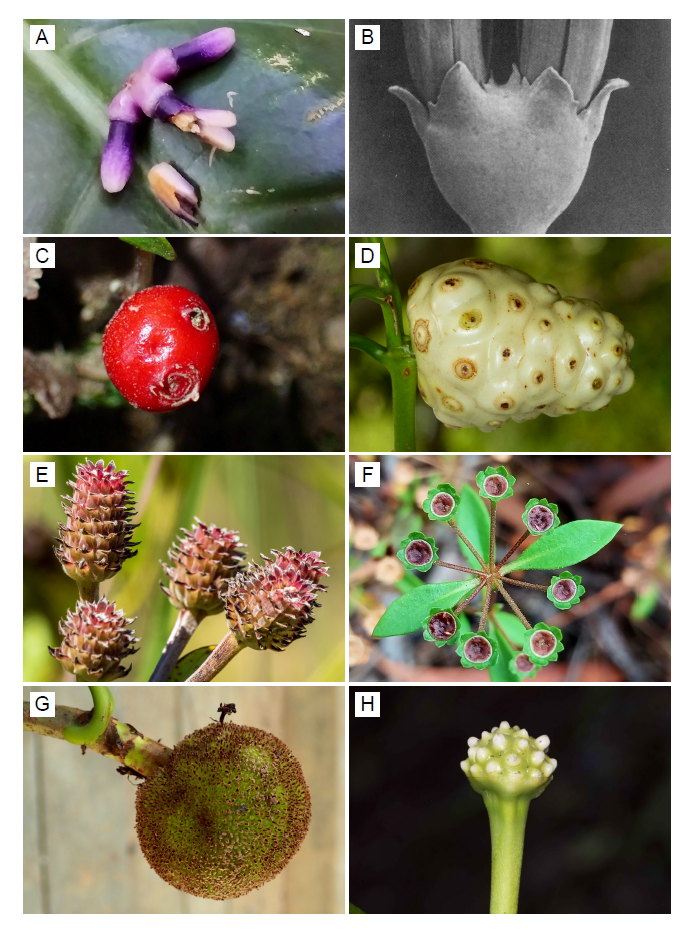
Multiple fruits are rare in Rubiaceae, occurring in only 14 genera. They have evolved in different ways in phylogenetically distant clades. We present a survey of all known occurrences of multiple fruits in the family. Leaving aside the poorly known genus Pagameopsis, we distinguish four types: (i) double or multiple drupes resulting from fusion of neighbouring ovaries Prismatomerideae, Mitchelleae and Morindeae), (ii) dry fruits resulting from partial fusion of a flower pair (Calanda in Knoxieae), (iii) dry multiple fruits dehiscing by an operculum (Anthospermeae – Operculariinae), and (iv) massive fleshy, woody or fibrous globose multiple fruits formed by expansion of the inflorescence tissue embedding numerous ovaries (Naucleeae). Based on this framework, we evaluated the systematic position of the Taiwanese genus Conjugatovarium, characterised by paired flowers with connate ovaries. Comparison of the characters excludes affinity with most lineages possessing multiple fruits due to major differences in habit, floral and fruit morphology, and biogeography. However, Conjugatovarium lalashanianum matches Mitchella undulata in all morphological characters, and both taxa co-occur in northern Taiwan. We formally place Conjugatovarium in synonymy with Mitchella and treat C. lalashanianum as M. undulata.
Downloads
Published
Issue
Section
License
Copyright (c) 2026 E. Robbrecht, B. Verstraete

This work is licensed under a Creative Commons Attribution 4.0 International License.
Please read our Open Access, Copyright and Permissions policies for more information.